
Every year at Easter thousands of cute and cuddly baby bunnies are sold in pet shops. Just a few months later most end up sick, dead or in animal shelters. Jan Scarlett, a veterinarian at Cornell University in the US, says up to 90% of bunnies bought at Easter as pets end up abandoned or don’t live to see their first birthday.

Why? Because as cute and cuddly as they are, bunnies are not easy to take care of. In fact, as prey animals evolved to escape predators, they do not like being cuddled or picked up or handled in any way. Their lightweight skeleton and fragile bones mean they are prone to fractures. Their specialised digestive system demands a highly varied diet. In addition, only one in 10 vets on average is properly trained to take care of rabbits.
If you already have a bunny in your care, there are several important steps to follow to ensure it lives a healthy and happy life.
WHAT TO FEED YOUR RABBIT
- Pellets are not enough. Feeding pellets alone can lead to dental problems and gastrointestinal stasis – a slowdown of muscular contractions in the intestine which pushes food through the gut. This can lead to a very painful death. Pellets are recommended only as part of a complete diet.
- Hay is essential for their teeth and digestion. Provide plenty of water both in a bowl and a bottle.
- Do not feed seeds or nuts, beans, dairy or meat as rabbits are strict herbivores.
- Salads are good: collard greens, mustard greens, dandelion greens, chard, kale, parsley, bok choy and spinach though avoid spinach in large quantities.
- Avoid lettuce like iceberg and romaine as the nutritional content tends to be very low.
- Rabbits also love fruit. Small amounts of apple or strawberries only as fruit can cause abdominal pain and gas.

HOW TO HANDLE YOUR BUNNY
Cuddle bunny is a misnomer: rabbits do not like to be picked up, cuddled or carried. They are prey animals and prefer to have their feet firmly on the ground.
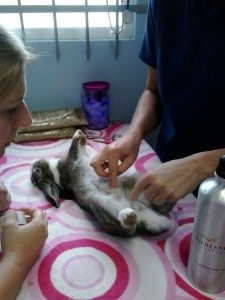
Rabbits are at greater risk for skeletal injury if handled improperly. Never lift by the ears or the scruff of the neck; always cradle the hindquarters and support the underside of rabbit. If rabbits are allowed to kick with their back legs while being carried, they risk generating enough force to cause injury to the vertebrae of their spinal columns.
MAKING A HOME
- Bunnies need a place to hide when they feel overwhelmed or frightened. A cardboard box for hiding, with two entry/exit holes so they never feel trapped, is good.
- Rabbits need exercise. Their cage must be large enough for them to hop a few times to get from one end to the other.
- Rabbits like to sit up and survey their surroundings; their cage must be tall enough.
- Solid bottom cages are kinder than wire-floored cages which may hurt their feet. Line the cage with newspaper.
- Bunnies should be sterilised when you take ownership as they breed prolifically.
BUNNY TOYS
Rabbits need to chew to keep their constantly growing teeth under control. Toilet paper rolls stuffed with hay, clean, dry pine cones and untreated wicker baskets are good bunny chew items.
They also like to dig and shred and punch and scrunch so give them cardboard boxes, paper bags, baskets filled with hay or newspaper, an old Yellow Pages directory, rubber or straw balls and a towel will provide hours of fun. Hang a carrot from the cage roof for playing and eating.
RABBIT DISEASES
Snuffles
According to Cornell University’s Shelter Medicine division, snuffles is one of the most common infectious diseases in rabbits. Common symptoms include nasal discharge, loud respiratory noise, lethargy, decreased appetite and weight loss.
Unfortunately, recurrent infections are common and total elimination of the disease is quite difficult, especially in a stressful shelter environment. The bacterium that causes snuffles in rabbits does not cause disease in cats or dogs.
Syphilis
Rabbit syphilis is characterised by crusty ulcerated lesions around the lips, eyelids, nose, and vulva or penis of rabbits. This disease is transmitted via direct contact between rabbits, and is highly contagious. It not transmitted to dogs, cats or humans.
Fleas
Fleas are common in rabbits and they share a flea species with dogs and cats. Never use Frontline (fipronil) on a rabbit, as it is fatal. Revolution and Advantage are the preferred flea medications for rabbits.
Sterilisation
Sterilising your rabbit is essential as rabbits are prolific breeders. They gestate for only 30 days, and usually have litters of between 4 and 12 babies (kits), depending on the breed. Once the babies are born, the doe can mate and get pregnant again as soon as the following day.
At Country Animal Clinic our vets offer basic bunny health care and sterilisation.
Call us at 021 851 1500 to make an appointment for your rabbit.
DID YOU KNOW? As a prey species, bunnies should never be housed in the same room as dogs or even in a place where dogs walk by.
